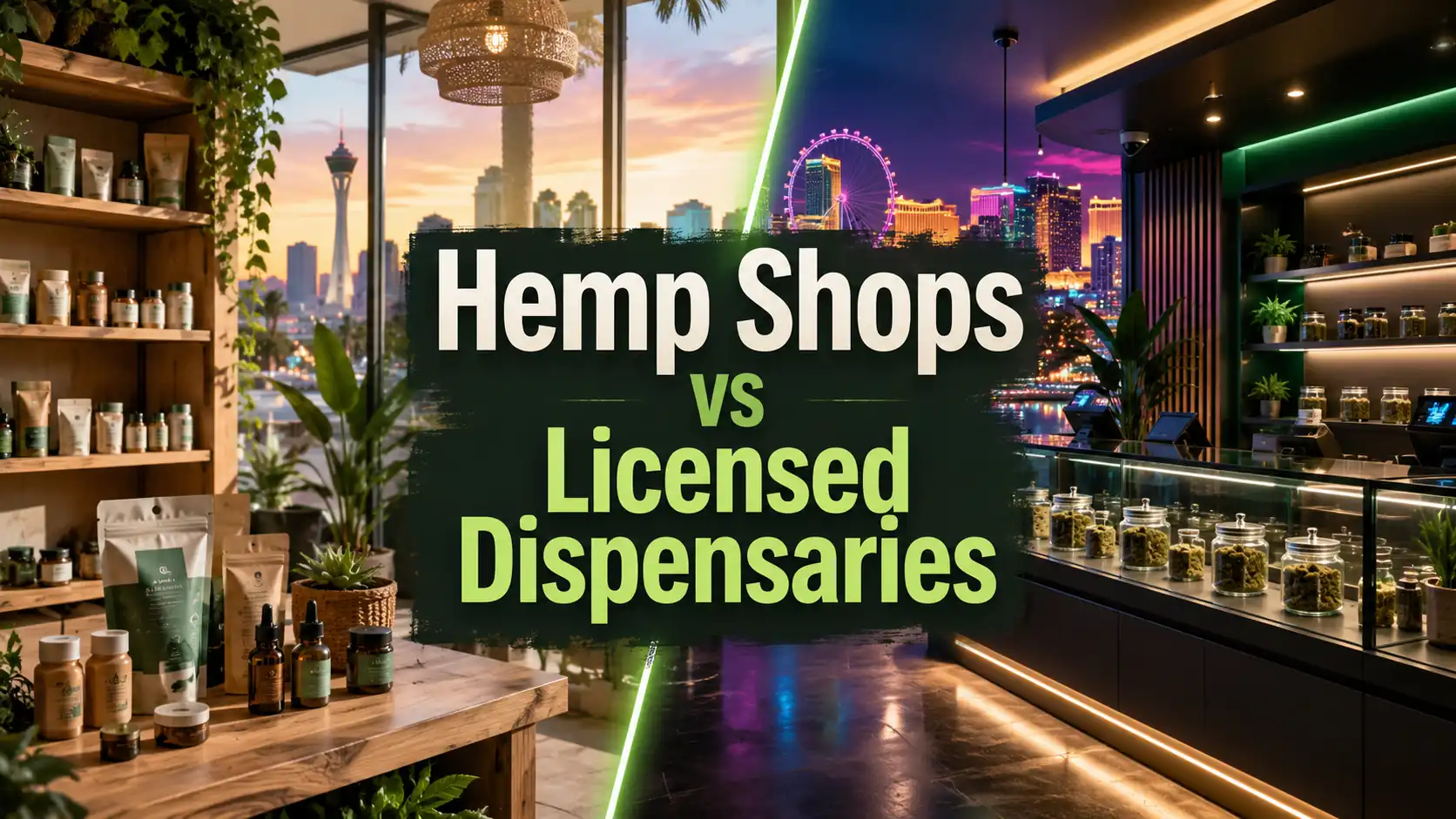
Across Las Vegas and beyond, cannabis shoppers are seeing more storefronts using terms like “hemp dispensary,” “THCA flower,” “legal THC,” and “Farm Bill compliant.” For many consumers, the language can feel confusing. Is a hemp shop the same thing as a licensed cannabis dispensary? Is THCA flower vs dispensary weed really different? Is a smoke shop selling cannabis, or something else entirely?
The short answer is this: not every store selling THC-style products is a state-licensed cannabis retailer. In Nevada, licensed cannabis businesses are regulated by the Nevada Cannabis Compliance Board, and the state says only licensed cannabis businesses may grow, manufacture, test, distribute, or sell cannabis. Consumers may legally buy cannabis only from a state-licensed retail store.
For shoppers in the Las Vegas Arts District, that difference matters. The Cannabis Co. is a licensed cannabis dispensary in Las Vegas, located at 200 E Charleston Blvd, with CEID License RD504. When you choose a licensed Nevada dispensary, you are choosing a regulated shopping experience with product testing, verified labeling, and compliance standards built into the process.
The Rise of Hemp Shops and Consumer Confusion
What Is a Hemp Dispensary?
A “hemp dispensary” is usually a retail store that sells hemp-derived products. These may include CBD, delta-8 THC, hemp-derived delta-9 gummies, THCA flower, vapes, beverages, or other cannabinoid products. Some of these stores may look and feel similar to cannabis dispensaries, but that does not automatically mean they are licensed by the state as cannabis retailers.
That is where the hemp dispensary vs dispensary question becomes important. A licensed dispensary is part of the state cannabis system. A hemp shop or smoke shop may operate under a different retail model, local business license, or hemp product framework. In practice, the consumer experience can look similar, but the regulatory structure behind the products may be very different.
Real Dispensary vs Hemp Shop: Why the Words Matter
The phrase “dispensary” has become part of mainstream cannabis language. But a real dispensary vs hemp shop comparison comes down to licensing, oversight, testing, sourcing, product tracking, and accountability.
In Nevada, the Cannabis Compliance Board regulates cannabis licensees and oversees strict regulation across licensing and operations to protect public health and safety. Licensed cannabis retailers operate within that system. Many hemp shops and smoke shops are not licensed cannabis sales facilities, even if they sell intoxicating hemp-derived products.
That does not mean every hemp product is automatically unsafe or unlawful. It does mean consumers should understand what kind of store they are buying from, what rules apply to the product, and whether the product has the same testing and tracking standards required in Nevada’s licensed cannabis market.
How the 2018 Farm Bill Created the Hemp THC Loophole
The Federal Definition of Hemp
The modern hemp marketplace grew after the 2018 Farm Bill. Under federal law, hemp was defined as Cannabis sativa L. and its derivatives with no more than 0.3% delta-9 THC on a dry weight basis.
That wording focused on delta-9 THC, which is the best-known intoxicating form of THC. As a result, companies began developing and selling products derived from hemp that could contain other cannabinoids, including delta-8 THC, delta-10 THC, hemp-derived delta-9 products, and THCA-rich flower.
This is what many people call the hemp THC loophole. In simple terms, some products could be marketed as hemp because they tested below 0.3% delta-9 THC before heating or conversion, even though they could still produce intoxicating effects.
Difference Between Hemp and Dispensary Cannabis
Botanically, hemp and marijuana-type cannabis come from the same plant species, Cannabis sativa L. The legal difference is based largely on THC thresholds and regulatory classification. The difference between hemp and dispensary cannabis is not always obvious from appearance alone.
For consumers, the more practical difference is where the product comes from and how it is regulated. Dispensary cannabis in Nevada moves through a licensed, state-regulated system. Products sold at licensed dispensaries are tied to testing, product records, labeling rules, and seed-to-sale systems.
Hemp-derived products sold outside the licensed cannabis system may follow different rules. Depending on the product and seller, they may not have the same state cannabis testing, potency verification, packaging standards, or compliance oversight.
The Science: What Is THCA and Why Does It Matter?
THCA Explained
THCA stands for tetrahydrocannabinolic acid. It is a naturally occurring acidic cannabinoid found in raw cannabis flower. THCA itself is not the same as activated delta-9 THC.
The key issue is heat. When cannabis is smoked, vaped, baked, or otherwise heated, THCA can convert into delta-9 THC through a process called decarboxylation. Scientific literature notes that THCA decarboxylates to THC during storage, fermentation, baking, smoking, and vaporizing.
This is why THCA flower vs dispensary weed can be confusing. A product may be marketed as “THCA hemp flower,” but if it is heated and inhaled, the THCA may convert into THC and produce intoxicating effects.
Why “Low Delta-9” Does Not Always Mean “Non-Intoxicating”
Some THCA products are marketed around the idea that they contain less than 0.3% delta-9 THC before use. But if the flower is rich in THCA, the experience after heating may be similar to traditional cannabis flower.
That is the core science behind the THCA marketplace. The product may be positioned as hemp before heat is applied, while the consumer may experience THC after heat is applied.
For shoppers, the practical question is not only “What does the package say?” It is also “Was this product tested for total potency? Was it screened for contaminants? Was it sold through a licensed cannabis retailer or a smoke shop?”
Licensed Dispensary vs Smoke Shop Cannabis
The Licensed Nevada Dispensary Standard
A licensed dispensary vs smoke shop cannabis comparison is really a comparison of systems.
Nevada’s licensed cannabis system includes licensed cultivation facilities, distributors, product manufacturers, testing laboratories, and retail stores. The state explains that testing laboratories are licensed to test cannabis and cannabis products for potency and contaminants.
That structure gives shoppers more than a product on a shelf. It gives them a regulated supply chain.
At a licensed Nevada dispensary, consumers can expect:
- Age verification
- Licensed cannabis sourcing
- Product labeling
- Potency information
- Testing documentation
- Inventory tracking
- Compliance with Nevada cannabis rules
- Trained staff who understand the regulated market
What May Be Different at a Smoke Shop or Hemp Store
A smoke shop or hemp store may sell products that look similar to dispensary cannabis products, including flower, gummies, vapes, or concentrates. But those products may not be part of Nevada’s cannabis tracking and testing system.
That difference can affect:
- Potency consistency
- Label accuracy
- Contaminant screening
- Product recall visibility
- Manufacturing oversight
- Consumer guidance
- Accountability if something goes wrong
Again, this is not about fear. It is about transparency. If two products look similar but one is sold through Nevada’s licensed cannabis system and the other is sold outside it, consumers should know the difference before buying.
Testing, Safety, and Potency: Why Regulation Matters
Licensed Dispensaries Rely on Verified Testing
In Nevada, licensed cannabis testing is extensive. The Nevada Cannabis Compliance Board’s 2025 Biennial Report states that laboratories are required to test for 6 cannabinoids, 10 terpenes, 23 pesticides, 5 mycotoxins, 4 heavy metals, 4 residual solvents, 10 microbial contaminants, foreign matter, water activity, pH, and percent moisture. Labs are also required to be ISO 17025 certified.
Read more here: NEVADA CANNABIS COMPLIANCE BOARD BIENNIAL REPORT 2025
That matters because cannabis is an agricultural product. Like any plant-based product, it can be affected by mold, pesticides, heavy metals, residual solvents, microbes, and handling conditions.
Nevada also provides a Cannabis Item Catalog where consumers can search products available at licensed dispensaries and consumption lounges, with comprehensive product and testing information, including downloadable Certificates of Analysis. The catalog pulls data from Metrc, Nevada’s seed-to-sale tracking system.
Potency Verification Helps Consumers Make Better Decisions
Potency matters for comfort, effect, and responsible consumption. A product labeled at 5mg THC is very different from one labeled at 50mg THC. A flower product testing at 18% THC is different from one testing at 30% THC.
Licensed dispensaries depend on lab-tested products with verified cannabinoid information. That helps shoppers understand what they are buying and supports more informed use.
By contrast, unregulated or less-regulated hemp-derived intoxicating products can vary more widely in how they are tested, labeled, and marketed. The FDA has continued to issue warning letters involving cannabis-derived products, including CBD and delta-8 THC products, and has stated that it continues to monitor the marketplace and act within its authority when appropriate.
Current Regulatory Landscape: Federal and State Scrutiny Is Increasing
Federal Efforts to Close the Hemp THC Loophole
The regulatory landscape is changing quickly. Federal law was amended in November 2025, with changes scheduled to take effect 365 days after enactment. The amended hemp definition will include total tetrahydrocannabinols, including THCA, at not more than 0.3% on a dry weight basis. It also excludes certain intermediate and final hemp-derived cannabinoid products, including products with more than 0.4mg combined total THC per container in specific circumstances.
For consumers, the takeaway is simple: the national conversation around intoxicating hemp products is moving toward tighter rules, clearer definitions, and more scrutiny.
This does not mean every hemp product disappears overnight. It does mean the old “delta-9 only” interpretation that shaped much of the hemp-derived THC market is under pressure.
Is THCA Legal in Nevada?
The question “is THCA legal in Nevada” does not have a simple one-size-fits-all answer for consumers. It can depend on the product, its THC profile, how it is tested, how it is marketed, and whether it is sold through Nevada’s licensed cannabis system.
Nevada has a regulated hemp program for production and agricultural handling, and the Nevada Department of Agriculture’s hemp FAQ notes that it regulates hemp production, hemp seed, and raw hemp processing, while end-consumer products are regulated by local health authorities. Nevada’s cannabis system is separate, and the CCB states consumers may only legally buy cannabis from a state-licensed retail store.
Because THCA converts into THC when heated, and because federal and state rules continue to evolve, consumers should be cautious about assuming that every THCA product sold outside a licensed dispensary is equivalent to regulated dispensary cannabis.
This article is for educational purposes only and is not legal advice.
Las Vegas Dispensary vs Hemp Store: What Shoppers Should Look For
When comparing a Las Vegas dispensary vs hemp store, do not stop at the storefront name. Ask better questions.
Questions to Ask Before You Buy
- Is the retailer a licensed Nevada cannabis dispensary?
- Can the store show product testing information?
- Does the label clearly list cannabinoids and potency?
- Is the product part of Nevada’s regulated cannabis system?
- Does the staff understand compliance, dosage, and responsible use?
- Is the product sold in packaging that follows cannabis rules?
- Can you verify the business location, license, and contact details?
At The Cannabis Co., shoppers can visit a licensed cannabis dispensary in Las Vegas with a listed CEID license, local address, and daily hours. Check out the Trusted Cannabis Shop menu for a full selection of flower, vapes, edibles, concentrates, prerolls, tinctures, and daily deals from The Cannabis Co.. Their menu also highlights rotating promotions on brands like Stiiizy, WYLD, Rove, Mojo, and Cannavore.
Why Buying From a Licensed Las Vegas Dispensary Matters
1. You Know Where You Are Buying From
A licensed Nevada dispensary operates within a regulated framework. That means the business is not simply selling THC-style products. It is participating in Nevada’s cannabis compliance system.
For locals, tourists, service industry workers, and Arts District visitors, that added clarity is important.
2. You Get Better Product Transparency
Licensed cannabis products are tested and labeled so shoppers can compare potency, cannabinoids, and product types. Whether you are shopping for flower, pre-rolls, edibles, vapes, or concentrates, clear testing and labeling help you make a more confident choice.
3. You Can Ask Real Product Questions
A quality dispensary is also an education point. TCC’s budtenders are available to answer questions about recreational cannabis, and the dispensary is located near Main St and 3rd St on Charleston Blvd in the Arts District of Las Vegas.
That human guidance matters, especially for newer consumers or anyone trying to understand THC potency, product format, onset time, and responsible use.
4. You Support a Compliant Local Cannabis Retailer
Choosing a licensed cannabis dispensary Las Vegas shoppers can verify helps support the regulated market. It also supports a safer, more transparent cannabis ecosystem for the community.
The Local Choice: The Cannabis Co. in the Las Vegas Arts District
As hemp-derived THC and THCA products continue to draw attention, consumers deserve clear information. Hemp shops, smoke shops, and licensed cannabis dispensaries may appear similar from the outside, but they do not always operate under the same rules.
If you are shopping in the Arts District, Downtown Las Vegas, Fremont East, or near the Strip, The Cannabis Co. offers a licensed, local option for regulated cannabis products. TCC is located at 200 E Charleston Blvd, Las Vegas, NV 89104, with CEID License RD504.
When quality, safety, compliance, and education matter, choosing a licensed Nevada dispensary is the clearest path. Visit The Cannabis Co. to shop lab-tested cannabis products, ask questions, and make your next cannabis purchase with confidence.
FAQ
What is a hemp dispensary?
A hemp dispensary is usually a retail shop that sells hemp-derived cannabinoid products. These may include CBD, hemp-derived THC gummies, delta-8 products, THCA flower, vapes, or beverages. A hemp dispensary is not automatically the same as a state-licensed cannabis dispensary.
The key difference is licensing and regulation. In Nevada, licensed cannabis retailers operate under the Nevada Cannabis Compliance Board’s regulated cannabis system. Many hemp stores or smoke shops may sell cannabinoid products outside that licensed dispensary framework.
Is THCA the same as marijuana?
THCA is not exactly the same as marijuana. THCA is a cannabinoid found in raw cannabis. Marijuana, or dispensary cannabis, refers more broadly to cannabis products regulated under state cannabis laws.
The reason THCA is widely discussed is that it can convert into delta-9 THC when heated through smoking, vaping, baking, or other heat exposure. That process is called decarboxylation. So while raw THCA is different from activated THC, THCA-rich flower may produce THC-like effects when heated.
Are hemp THC products legal in Nevada?
The legality of hemp THC products in Nevada can depend on the product type, THC concentration, testing method, how the product is marketed, and where it is sold. Nevada has a hemp program, but Nevada also has a separate regulated cannabis system for cannabis products sold through licensed dispensaries.
Because laws and enforcement priorities can change, consumers should avoid assuming that every hemp-derived THC or THCA product sold in a smoke shop is equivalent to licensed dispensary cannabis. For regulated cannabis purchases, Nevada consumers should choose a state-licensed cannabis retail store.
What’s the difference between a licensed dispensary and a smoke shop?
A licensed dispensary is authorized to sell cannabis through Nevada’s regulated cannabis system. Products sold through licensed dispensaries are tied to state compliance rules, testing requirements, labeling standards, and seed-to-sale tracking.
A smoke shop may sell accessories, tobacco-related products, CBD, hemp-derived cannabinoids, or other retail goods. It may not be licensed as a cannabis dispensary. That means products sold there may not follow the same testing, potency, labeling, or tracking requirements as licensed dispensary cannabis.
Why are licensed dispensaries safer?
Licensed dispensaries are generally safer because they operate within a regulated system that requires product testing, labeling, age verification, licensed sourcing, and compliance oversight. In Nevada, cannabis testing laboratories are required to test for cannabinoids, terpenes, pesticides, mycotoxins, heavy metals, residual solvents, microbial contaminants, foreign matter, water activity, pH, and moisture.
This does not mean every licensed product is perfect. It means there is a formal process for testing, documentation, accountability, and consumer transparency.
Can hemp-derived THC products get you high?
Yes, some hemp-derived THC products can get you high. Products containing intoxicating cannabinoids such as delta-8 THC, hemp-derived delta-9 THC, or THCA that converts into THC when heated may produce psychoactive effects.
Consumers should read labels carefully, start with low amounts when trying any THC product, avoid mixing with alcohol or other substances, and never drive after consuming intoxicating cannabis or hemp-derived THC products.